Thursday, December 6, 2012

December 2012 BMP Q&A


By: Todd Thomas, Water Resources Forester, Texas A&M Forest Service

Q: Awhile back I noticed on some closed out skid trails that had been revegetated, not only was rye grass used, but they had also used some clover in the mix.  Is there any benefit to planting clover when in areas that you are revegetating?

Revegetated Logging Road, East Texas
A: I am always glad to hear about revegetation, as it is an excellent method of preventing erosion on roads and other disturbed areas.  It is even better to hear of the clover being used in the mix.  This is because clover is a type of plant that is also known as a “legume”.  Legumes can be important in areas where there has been a considerable amount of soil disturbance such as a skid trail or approach to a stream crossing. 

Legumes perform what is called nitrogen fixation.  In other words, they take nitrogen from the air and put it back into the soil.  Nitrogen is an extremely important nutrient for plant growth.  This is why sometimes in agricultural operations you will see peanuts or soybeans used in crop rotation, since they can contribute nitrogen back to the soil that was depleted by the previous crop.  In an area with a great deal of disturbance it is important to incorporate something in your revegetation that can contribute back to the soil not only by helping to hold it in place, but by delivering a much needed nutrient that will help other grasses to grow, further preventing erosion. 

Subterranean clover
On page 66 of the blue book, it says that “legumes should be used in mixes with grasses.”  On the next page it gives some options for different legumes to use.  The legumes that we recommend incorporating are Singletary peas, Hairy vetch, Arrowleaf clover, and Subterranean clover.  However, if you choose to incorporate another legume, that is great also.  In general, all clovers, as well as plants that have some sort of seed pod (such as peas or beans) are legumes. 

A side benefit of planting legumes is that they are a great food source for wildlife.  Most legumes are high in protein, and all our deer hunters out there know that additional protein can increase antler growth in whitetail deer.  I’m sure the landowner will be extra happy knowing that you have helped their quest for “Muy Grande”.  This is just a side benefit while you are doing an excellent job at rebuilding soil productivity and reducing erosion. 

So remember to always include legumes in your revegetation and to keep the questions coming.  You can email me your questions at tthomas@tfs.tamu.edu or by phone at (936)639-8180.  Also, be sure to pay a visit to our blog at http://tfswater.blogspot.com.  On the blog you can find old Q&A articles, as well as additional information on how to best keep our waters clean while providing the world with forest products.  


*This article was published in the December 2012 issue of the Texas Logger

Tuesday, November 6, 2012

November 2012 BMP Q&A


By: Todd Thomas, Water Resources Forester, Texas A&M Forest Service

Q: Just the other day, the topic of temporary stream crossings came up.  More specifically, how does TFS recommend that we cross streams and how should they be left after operations are complete on the site? 

A:  Excellent question, if you don’t give proper care and thought to your temporary stream crossings, many of the BMPs you have put into place on the tract can be negated.  A key component of any forest management activity is access.  In some cases you may not have to cross streams to access parts of a tract that you need to.  For instance, there may be another entrance or road that has been overlooked, a neighboring landowner may grant access through their property, or it may not be necessary at all once you have stepped back and looked at the bigger picture. 

More often than not, you are going to have to put in a stream crossing or two to get the job done, but remember to keep them to a minimum.  When selecting a location be sure and look for a straight, narrow section of stream with relatively low banks.  This will minimize the amount of disturbance to the stream and stream banks.  Higher banks result in a greater amount of disturbance than lower banks, and straight, narrow sections limit the amount of exposure the streambed receives from equipment.  Once you have selected the appropriate location, be sure that your approaches to the stream as well as the crossing itself is at a 90 degree angle to the stream, this ensures that as equipment crosses, the amount of the stream exposed to equipment is greatly reduced. 

Log skidder dragging logs across a temporary bridgemat
If the banks of the stream are too high for equipment to cross directly, a common approach is to lay slash bundles into the stream bed that can be driven across.  The only downside to this is that they must be removed following operations; this can take some effort and can result in a serious amount of disturbance.  However, this is a much better option than dirt crossings.  Dirt crossings should never be used and are never recommended.  Remember, the point of BMPs is to keep extra dirt from entering the streams, not to add any more.  One of the easiest alternatives for these types of crossings is to use bridgemats, otherwise known as skidder mats or dragline mats.  These mats are constructed of hardwood cants that have been bolted together and are extremely durable and can be used over and over again.  They can be laid in place with the grapples of the skidder and removed in the same fashion once you are done.  The best part is that you have stayed out of the stream bed completely and maximized water quality protection at your temporary stream crossing. 

Once it is time to move off site, temporary stream crossings should be removed and the approaches should be stabilized to reduce erosion.  One way to stabilize approaches is by revegetating them.  On page 65 of the most recent BMP handbook there are guidelines for revegetating disturbed areas, there is even a chart that gives you different seeding options so that you can use the best seed for your site.  Another alternative is to distribute fine slash down the approach (being sure not to put any in the stream bed) and drive over it to ensure firm placement, followed by larger, more coarse slash. 

In conclusion, remember to keep stream crossings to a minimum, always stabilize your approaches and to never use dirt crossings.   Keep the questions coming so we can shed some light on any best management practice confusion that might be out there, you can send your questions to me at tthomas@tfs.tamu.edu or just phone it in by calling (936) 639-8180.

*This article was published in the November 2012 issue of the Texas Logger

Thursday, November 1, 2012

Polk County Landowner Meeting

On Saturday, October 27, Texas A&M Forest Service personnel helped to put on a meeting in Livingston, Texas for landowners in Polk County.  The meeting was sponsored by the Sustainable Forestry Initiative (SFI) and the Texas Forestry Association.  60 landowners showed up to increase their knowledge of sound forest management and issues surrounding modern forestry.

The topics and speakers included
  • The Sustainable Forestry Initiative (SFI)
    • Steve Mayo, MeadWestvaco
  • East Texas Land Sales and Acquisitions
    • Wes Kilpatrick, Walsh Land Brokers
  • Legislative Update
    • Ron Hufford, Texas Forestry Association
  • Woodville Renewable Power Project
    • Ryan Thomas, East Texas Electric Cooperative, Inc. 
  • Multiple Use Forestry
    • Gary Burns, Burns Forestry
  • Lonleaf Pine: Past, Present, and Future
    • Jared Goodman, Texas A&M Forest Service
  • BMPs: What You Should Know as a Forest Landowner
    • Todd Thomas, Texas A&M Forest Service
Not only was it a good learning experience for forest landowners, it was an opportunity for many of them to become acquainted with one another as well as for the Polk County Landowner Association to boost their membership.  Landowner associations play in an integral role in landowner education, ensuring that the members are aware of current issues and sound forest management.  

Friday, October 26, 2012

SFASU Students Learn About BMPs


This past week, Regional Forest Health Coordinator Joe Pase and Water Resources Forester Todd Thomas, taught a lab in northwest Nacogdoches County for the forest ecology class from Stephen F. Austin State University.  The class was composed of 33 students who were either forestry or environmental science majors.  The students got to learn about the Texas A&M Forest Service's Best Management Practices (BMP)  program, view BMPs that had been implemented on the ground, benthic macroinvertebrates, and how BMP effectiveness monitoring is conducted.  Some of the BMPs that the students got to see first hand included, streamside management zones (SMZs), remediated and revegetated stream crossings, water bars, wing ditches, and rolling dips.  The Texas A&M Forest Service has been helping with these labs every fall and spring semester since 1994 and has reached more than 1,000 SFASU students over the years.  


Friday, October 5, 2012

Utilization of logging residue or slash

Not this Slash.  

Today I would like to take some time to focus on logging residue, also known as “slash”.    All too often when someone passes by a timber harvest, they see the slash scattered about the area and think to themselves, “Look at all that wasted wood”.  There is no need for concern here, for that wood has not been wasted at all.  When it comes to reducing overland flow and the erosion that occurs as a result, slash does an excellent job.  Due to the nature of the operation, slash is in abundance, so why not utilize a material that is already on site and in bulk?  In addition to reducing erosion, slash contributes nutrients to the soil.  As it decomposes, the nutrients in the slash are returned to the soil.  So not only are the nutrients that are already there retained instead of washing away, more nutrients are deposited!

It is especially important for slash to be distributed in highly sensitive areas, or areas that are the most erosion prone.  Woods roads or skid trails that are going to be closed following the operation should have slash distributed down them in such a manner to keep them from washing out.  This entails putting down the finer slash first and running over it with a skidder to get it down into the soil, followed by larger slash.  The amount of slash put out depends on how much potential there is for erosion, however, it’s pretty hard to overdo it. 

Skid trail stabilized with slash
Skid trail in a clearcut stabilized with slash
Another sensitive area that can benefit from distributing slash on it is the approaches for stream crossings.  The slash should be put down just as you would when closing down a woods road to hold the soil in place and keep it from entering the stream.  It is important to take note that the slash is put down on the approaches to the crossing, but not down in the stream bed itself.  If excessive slash is left in the stream bed, then those excess nutrients will end up in the stream as the slash decomposes, posing water quality risks.  Even worse, slash in the stream bed will eventually dam up the stream creating issues both up and downstream.  A common approach to crossing streams where low water crossings are not practical is to use a bundle of slash in the stream so that equipment can drive over it.  These crossings should be removed immediately as soon as operations are complete to prevent negative impacts to water quality. 

Stream Crossing approaches stabilized with slash

Other sensitive areas such as steep slopes or areas with highly erodible soils can benefit from slash distribution as well.  The slash will keep these areas from eroding until vegetation can re-establish itself and continue to keep the soil intact.  In most cases the slash has more or less decomposed at this point, and vegetation has taken over and erosion is still kept to a minimum.  


Friday, September 28, 2012

Texas NRCS Personnel Attend Forestry BMP Training


On Tuesday, September 25 in Jefferson, Texas and on Thursday, September 20 in Lufkin, Texas NRCS personnel attended training put on by TFS water resources staff to become more familiar with Texas Forestry Best Management Practices.  This was an opportunity for some to become newly acquainted with forestry BMPs and for others to be refreshed.  All aspects of the BMP program were covered in the morning session of the class to ensure that all those attending had been exposed to forestry BMPs as well as to facilitate discussion on some issues they might face in their jobs. 

After lunch, the classes visited recently harvested tracts to view these best management practices first hand.  At the field sites, the students were able to identify different stream types, view and discuss streamside management zones (SMZs), look at various stream crossing methods, view and discuss water control structures and other aspects of timber harvesting, and how BMPs are implemented in these activities.  The ultimate goal of these classes was for NRCS personnel to leave with a greater understanding of forestry BMPs to aid landowners in protecting soil and water resources.  

Thursday, September 6, 2012

September 2012 BMP Q&A

By: Todd Thomas, Water Resources Forester, Texas A&M Forest Service


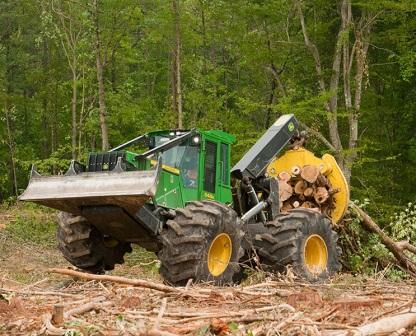
Q: Sometimes in order to speed things up, our skidder operator will delimb logs using what is called “backing".  This is where he takes the logs with the skidder grapple and backs them into standing timber, knocking off the limbs before they get to the landing.  Recently I was told that this was not a good practice and that we should not do this anymore.  Are there any BMPs related to this, and why should we not do it?

A: Excellent question, and one that certainly needs to be addressed.  While there are no BMPs that specifically mention “backing", it is something that should not be practiced, especially if it is done in an area where the trees will not be completely harvested, as is the case of a Streamside Management Zone (SMZ).  Backing whole trees in for delimbing can cause excessive damage to the residual stand, making them more susceptible to insects and disease and possibly resulting in mortality.  This completely defeats the purpose of leaving them standing, and if in an SMZ, may not provide the same level of water resource protection. 

In addition to damaging trees, the nature of this process involves equipment intrusion into the SMZ.  If you recall, Texas Forestry BMPs call for equipment traffic to be kept to a minimum within the SMZ, as well as for the “forest floor to be essentially undisturbed".  By backing logs in, these BMP guidelines have not been followed.

Another way in which backing damages SMZ is the potential to create ruts at the edge of the SMZ.  Even if these ruts are small, they can become a direct channel to carry runoff water to the stream and increase erosion.  You can also push back too far, damaging the stream bank itself, and causing it to fail.  While you may have strived to follow BMPs across the entire tract, this simple process can negate the other BMPs by delivering soil directly to the stream. 

Texas Forestry BMPs call for streams to be “clear or debris, such as tops and limbs”.  While you may be pushing the limbs back at the edge of the SMZ, you run the risk of pushing them into the stream.  Even though tops and limbs can fall into the stream bed naturally from storms and dead trees, there is no need to increase this debris from a practice that is not necessary.  As these tips and limbs decompose, they release nutrients that can reduce water quality.  When stream flow increases during rainy weather, limbs and tops are pushed downstream and can dam up the stream, increasing the potential for flooding.  As the limbs are pushed down even further, they can gouge the stream banks, increasing the erosion that occurs naturally within the stream, as well as increasing the amount of soil in the water.

In conclusion, even though skidder operators are well intentioned and are just trying to help out the guys up at the landing, this is a practice that needs to go by the wayside.  It is not worth the damage that can be incurred to the SMZ or the stream, and I wonder about its’ efficiency to the overall operation.  Keep the questions coming so we can shed some light on any best management practice confusion that might be out there, you can send your questions to me at tthomas@tfs.tamu.edu or just phone it in by calling (936) 639-8180.


*This article was published in the September 2012 issue of the Texas Logger