Showing posts with label Wildfire. Show all posts

Tuesday, June 26, 2012

Texas Forest Service Resource Specialists Learn About BMPs

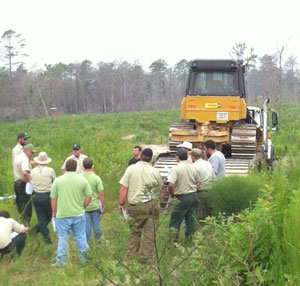
BMPRecently-hired resource specialists got a chance to learn about water quality protection issues during a workshop in Hudson.

Forester Todd Thomas and Resource Specialist Bernie Buckner led the class to expose the new employees to Best Management Practices.

“The BMP training helped newer staff learn how to help mitigate water quality issues while they’re working in the forest,” said Forester Todd Nightingale. “They will be able to use what they learned to assist forest landowners with information, and it will help make them more proficient at fireline rehabilitation operations after wildfires.”

Participants got to install waterbars and learned how to manage site disturbances to reduce impacts to local waterways.

Wednesday, April 11, 2012

Post-Fire Erosion Control Measures

On January 13, 2012, the Lost Pines Recovery Team in Bastrop County provided a free educational workshop for landowners affected by the recent wildfires. The topics covered a wide range of subjects, providing information useful to to any landowner impacted by the recent wildfires in Texas (not just those in Bastrop County). The Texas Forest Service Water Resources Program presented information on erosion control measures that landowners can take following wildfire to reduce the risks of soil and water degradation.

The presentations are available online as a standard PDF document, or as a video of the presentations. To access them click on the images below:


To view the PDF documents you will need to have Adobe Acrobat Reader installed on your computer. The software is available as a free download from the Adobe website. To view the video presentations you will need to have Apple QuickTime. The software is also available as a free download from the Apple website.


Additional information on post-fire erosion control can be found on the Bastrop County disaster recovery/relief website (http://www.co.bastrop.tx.us/bcdisaster/index.php/soilsaerosion).


Thursday, March 1, 2012

March BMP Q&A

By: Chuck Coup, Water Resources Forester (Ret.), Texas Forest Service

Q:  I have a client in East Texas whose timberland was damaged by the 2011 fires. The streamside management zones (SMZs) were damaged as well, and I am trying to give some advice on restoring these areas in order to continue protecting water quality. Would it be better to allow these areas to naturally heal or should I recommend taking action? 

A:  That is a really good question, and I would imagine that many of you might have been wondering the same thing.  As we all know, the two primary purposes of an SMZ are to reduce or eliminate the potential for nonpoint source pollution, like sediment and logging debris, from reaching streams, and to maintain cool water temperatures. Of course, they also provide other important benefits like maintaining the integrity and function of the stream, providing habitat and cover for wildlife, and helping with the aesthetics of the site. We all know that SMZs are important areas that serve important functions, so what do we do if they are burned in a wildfire?  Do we stand back or take action?

It can be a tricky situation, so here is what I would suggest:

First, start by making an initial assessment of the impacted SMZ to determine the severity of the damage, the density of surviving trees, the potential for regeneration, and the immediate threat to water quality. Once you have done that, you just might have enough information to conclude that the SMZ can heal itself on its own in a reasonable amount of time. That would certainly be the case in less severely burned areas where the basal area of surviving trees is at or near the recommended 50 square feet per acre and evenly distributed (refer to your BMP handbook if you need a refresher on basal area), the SMZ is still at least 50 feet wide on either side of the stream channel, the canopy trees are mostly intact or likely to survive, new tree seedlings and other vegetation are sprouting across the ground, and erosion does not appear to be a significant problem. However, these can be very tricky things to judge, especially if you don’t have much experience. In that case, I would certainly recommend getting some help from a professional forester.

In some situations it might be necessary to salvage at least part of the SMZ and possibly even replant it. This might be the case where the fire was severe, killing most of the trees and leaving very little vegetation, the SMZ does not appear to be re-growing on its own, and the lack of vegetation has led to substantial erosion concerns. Again, get help from a professional forester if you are unsure. If salvage and artificial regeneration are necessary I would strongly recommend that you take appropriate precautions and follow all applicable BMPs. Be especially careful to minimize the amount of ground disturbance resulting from your operations. As always, keep haul roads, skid trails, and landings outside the SMZ and avoid or minimize stream crossings. Trees and tops should not be felled across or pushed into the channel, and every effort should be made to protect and leave trees in the SMZ that are not severely damaged.

If re-planting is deemed necessary after evaluating the regeneration potential of the SMZ, then site preparation and machine planting should be avoided within the SMZ. When replanting, every effort should be made to ensure that the number of seedlings planted will meet the minimum recommended basal area of 50 square feet per acre and that the SMZ will encompass the standard 50 foot width on either side of the stream channel. Herbicide and fertilizer use should be limited within the SMZ and applied with extreme caution. Seeding or other erosion control practices could be installed to temporarily control short-term erosion issues until the SMZ becomes re-established.

The initial assessment should help you decided on a strategy for restoring the various conditions across the SMZ. In some situations it might make sense to stand back and let nature take its course, while prudent management might be appropriate for others. Either way, make sure you consider the potential impacts to water quality and follow all appropriate Best Management Practices. For a copy of the BMP handbook visit your local Texas Forest Service office or view online at http://txforestservice.tamu.edu/water.  For questions regarding repairing damaged SMZs or BMPs in general please contact me by calling (936) 639-8180. 

*This article was published in the March 2012 issue of the Texas Logger
Tuesday, November 1, 2011

November BMP Q&A

By: Chris Duncan, Water Resources Forester (Ret.), Texas Forest Service

Q: We own several hundred acres of timberland which were lost due to the recent wildfires in East Texas. We have spoken with our consulting forester and are planning on conducting some salvage harvesting operations. Our property has a fairly good sized stream which usually flows 3-4 months out of the year during the wetter months. Most of what we will be harvesting was completely or nearly completely killed by the fire, although there are some areas with higher survival. I would like to know if you have any recommendations on how we should conduct our harvesting so that we have as little impact to water quality as possible.
 
A: Sorry to hear about your loss of timber during this unprecedented fire season. I am glad to hear that you have consulted a professional forester to help you with the recovery of some of your timbers value. I would be happy to provide some recommendations for Best Management Practices which will help you reduce the risk of impacting your streams water quality during your operations. It appears you likely have an intermittent stream that flows through your property based on your description of the stream. Let’s start with the Streamside Management Zone (SMZ) along this stream.

SMZs provide several functions to help protect water quality. One of an SMZs primary functions is to provide shade to the water body. The shade provided by an SMZ helps regulate the water temperature, thereby protecting the thermal qualities of the stream. Many organisms have small tolerances to large thermal changes. Therefore, care should be taken during wildfire salvage operations not to remove more trees from the SMZ than absolutely necessary. Your forester should survey the SMZ, and make determinations of which trees will likely die from the fire, and which trees may survive. We recommend that any trees which may survive be left uncut to provide as much shade to the stream as possible. A good rule of thumb for hardwoods in the SMZ may be to leave any trees which still have at least 50% of their crown intact. As far as the pine trees go, if they are going to die from the fires we had this year, they have probably already turned brown and dropped their needles. Any pine trees which still have a majority of the crown in lush green needles should be saved if possible.

While selectively harvesting within the SMZ, care should be taken to disturb the ground as little as possible to maintain the SMZs protection of the stream from runoff. If the vegetation on the ground within the SMZ was completely consumed, efforts should be made to re-establish vegetation as soon as possible.

On rare occasion (flat terrain, lightly erodible soils, and cooler burned areas), a forester may use his professional judgment to determine if it is safe to narrow an SMZ so that it is less than the recommended 50’ on each side of a stream during salvage operations to recover some of the value. If it is determined that an SMZ will be narrower (maybe 30’– 40’ feet wide) than the 50’ recommendation, efforts should be made to disturb the soils and vegetation that would normally fall within the recommended SMZ as little as possible. Any mechanical or chemical site preparation or machine planting should be conducted outside the original 50’ buffer to reduce the risk of impairing water quality.

As far as the rest of the tract outside the SMZ; the harvesting, site preparation, and planting should all be conducted in accordance with all other BMP guidelines in the bluebook.

If you have any questions about wildfire salvage BMPs or any other BMPs please contact me.

* This article was published in the November 2011 issue of the Texas Logger

Sunday, May 1, 2011

The Texas Water Source - May 2011

May Issue of the Texas Water Source Now Available

      May BMP Q&A

      By: Chuck Coup, BMP Forester (Ret.), Texas Forest Service

      Q:   In recent months the outbreak of wildfires and the threat of wildfires occurring has been high.  I want to protect my timber from a possible wildfire by installing firelanes around my tract.  Are there any BMPs that I should follow during this project to prevent any impacts on water quality from occurring?

      A:   Installing firelanes around your timber is a great way to protect your investment by reducing the threat of a possible wildfire.  Firelanes work by creating a barrier and removing the available fuel source between adjoining stands or tracts.  By removing the fuel source along these barriers aids in preventing a wildfire one stand or tract to another.  However, it is important to remember that there are potential impacts to water quality that can occur if caution is not taken. 

      Guidelines for properly constructing and maintaining firelanes can be found in the Texas Forest Service’s BMP Bluebook.  These recommendations are designed to prevent any unnecessary erosion form occurring thus minimizing the potential for impacts on water quality. 

      Firelanes should be constructed along the perimeter of the tract and follow the boundaries of Streamside Management Zones.  Locating these barriers outside of SMZs will limit the amount of sedimentation that may result.  This will also protect the litter and organic matter of the SMZ so it can continue to serve as a filter.    

      To allow for proper drainage and erosion control, waterbars and wing ditches should be installed in a timely manner.  Recommendations for installing these devices can be found on pages 34 and 38 of the BMP Bluebook.  These recommendations include how to properly build waterbars, proper spacing for waterbars, and specifications on properly installing wing ditches.  When installing wing ditches, make sure that the runoff water is not being discharged directly into streams.    

      Regular maintenance on firelanes is necessary to avoid potential erosion problems.  This includes periodic inspections, especially after heavy rains, to make sure that they are still functioning properly and are not washed out.  Mowing, rather than blading, is the preferred type of maintenance because it minimizes the amount of exposed mineral soil.  Care should be taken when blading is the only option. 

      Implementing these control structures can be very costly when using heavy machinery.  For economical as well as environmental reasons, it is important to only build firelanes as wide and deep as necessary.  Woody debris and other flammable material should be kept away from firelanes.  These objects can ignite, creating a pathway for the fire to spread into SMZs or adjoining lands.  If you have a question regarding BMPs, please call me at (936) 639-8180.

      * This article was published in the May 2011 issue of the Texas Logger

      Saturday, July 1, 2006

      July BMP Q&A

      By: Shane Harrington, BMP Forester (Ret.), Texas Forest Service

      Q: In recent months the outbreak of wildfires and the threat of wildfires occurring has been high.  I want to protect my timber from a possible wildfire by installing firelanes around my tract.  Are there any BMPs that I should follow during this project to prevent any impacts on water quality from occurring?

      A: Installing firelanes around your timber is a great way to protect your investment by reducing the threat of a possible wildfire.  Firelanes work by creating a barrier and removing the available fuel source between adjoining stands or tracts.  By removing the fuel source along these barriers aids in preventing a wildfire one stand or tract to another.  However, it is important to remember that there are potential impacts to water quality that can occur if caution is not taken. 

      Guidelines for properly constructing and maintaining firelanes can be found in the Texas Forest Service’s BMP Bluebook.  These recommendations are designed to prevent any unnecessary erosion form occurring thus minimizing the potential for impacts on water quality. 

      Firelanes should be constructed along the perimeter of the tract and follow the boundaries of Streamside Management Zones.  Locating these barriers outside of SMZs will limit the amount of sedimentation that may result.  This will also protect the litter and organic matter of the SMZ so it can continue to serve as a filter.    

      To allow for proper drainage and erosion control, waterbars and wing ditches should be installed in a timely manner.  Recommendations for installing these devices can be found on pages 34 and 38 of the BMP Bluebook.  These recommendations include how to properly build waterbars, proper spacing for waterbars, and specifications on properly installing wing ditches.  When installing wing ditches, make sure that the runoff water is not being discharged directly into streams.   

      Regular maintenance on firelanes is necessary to avoid potential erosion problems.  This includes periodic inspections, especially after heavy rains, to make sure that they are still functioning properly and are not washed out.  Mowing, rather than blading, is the preferred type of maintenance because it minimizes the amount of exposed mineral soil.  Care should be taken when blading is the only option. 

      Implementing these control structures can be very costly when using heavy machinery.  For economical as well as environmental reasons, it is important to only build firelanes as wide and deep as necessary.  Woody debris and other flammable material should be kept away from firelanes.  These objects can ignite, creating a pathway for the fire to spread into SMZs or adjoining lands.  If you have a question regarding BMPs, please call me at (936) 639-8180.

      * This article was published in the July 2006 issue of the Texas Logger

      Friday, October 1, 2004

      October BMP Q&A

      By: Shane Harrington, BMP Forester (Ret.), Texas Forest Service

      Q:  I am a logger in Southeast Texas and for the past few weeks I have been watching the hurricanes slam the East Coast.  The possibility of a hurricane causing damage to timber here in East Texas is not too far-fetched.  Even more damage can be caused here by wildfires, wind, and Southern Pine Beetle outbreaks that could happen at anytime.  Do I still need to follow BMP guidelines during salvage operations when I am trying to get the timber out as quickly as possible?

      A:  Great question.  Timber can sustain a lot of damage from events such as hurricanes, wildfires, and Southern Pine Beetle outbreaks.  Hopefully we will not have any widespread timber damage here in East Texas.  However, if you find yourself conducting a salvage operation after such an event BMPs should be implemented just as if it were a normal harvest operation. 

      Generally there is a since of urgency when it comes to harvesting timber in a salvage operation because damaged trees are more susceptible to insects and disease, lowering their economic value.  It is still important to implement BMPs during these situations.  BMPs are effective in  preventing or reducing erosion, allowing your land to be managed in a sustainable manner.    Following are a few recommendations to consider while conducting a salvage operation.

      Prior to the salvage operation, the ground should be inspected to ensure that it is stable enough to support heavy machinery.  Often times after an event such as a hurricane, tropical storm, or even an East Texas thunderstorm, the soil is saturated and operating heavy machinery on these soils can cause rutting.  Rutting creates channels for water flow, which can lead to widespread soil movement.  This reduces site productivity, decreases tree growth and financial returns, and impacts water quality.  Firelanes installed to control wildfires should be cleaned up and stabilized with the proper water control structures to prevent additional erosion. 

      Streamside Management Zones (SMZs) should be visibly marked and all operations within the SMZ should be kept to a minimum.  It may be necessary to flag the SMZ for greater visibility, because it is sometimes difficult for machine operators to see the original painted line with the additional debris on the ground.  All roads, skid trails, decks, and firelanes should be located outside the SMZ.  Removal of any felled timber within the SMZ should be done by dispersed skidding or by cable retrieval.  This is done to prevent damaging the filtering capabilities of the SMZ and to keep the forest floor virtually undisturbed.  Remember, even in salvage operations, 50 square feet of basal area should be left in the SMZ.  Try to leave trees that have not been too severely damaged.    

      Personal safety should also be stressed when conducting a salvage operation.  Treetops and limbs may be left dangling above the ground and could cause serious injury to ground personnel.  It is also important to be aware of machine operators, especially when visibility is impaired from excessive debris.

      For other recommendations regarding BMPs and salvage operations please refer to the Texas Forest Service BMP Bluebook.  If you do not have a copy of the Bluebook you can obtain a copy from your local Texas Forest Service office or online at http://txforestservice.tamu.edu/water.  If you have any questions or comments regarding BMPs please call me at (936) 639-8180.

      * This article was published in the October 2004 issue of the Texas Logger