Showing posts with label Waterbars. Show all posts
Showing posts with label Waterbars. Show all posts
Tuesday, December 22, 2015

Friday, August 31, 2012
The basics of waterbars and wing ditches
The primary pollutant that enters our waterways from forestry operations is sediment. This sediment comes mostly from roads, skid trails, and firebreaks. Sediment is carried from overland flow that has gained enough velocity to detach soil particles and carry them with it; this overland flow, if not slowed down and dispersed, ends up in the stream, sediment and all. One method of slowing down overland flow, as well as dispersing any sediment that it is carrying with it is to construct waterbars in trails, roads, and firebreaks.


 Waterbars and wing ditches should never discharge into streams. This increases stream bank erosion as well as increases the amount of sediment that enters the stream as a result of operations.
 |
Waterbars should be constructed at a 30-45 degree angle, turning overland flow out and away from the road.
 |
Accompanying a waterbar should be some sort of a turnout, more commonly referred to as a "wing ditch." As the overland flow is intercepted by the waterbar, it is diverted into the wing ditch and dispersed before it has the opportunity to gain speed and cause further erosion. It is also important to note that wing ditches should be constructed to be more flat than v-shaped. This encourages diverted flow to dissipate rather than be concentrated.

When constructing waterbars it is important to be sure that both ends are tied in to the edge of the road. This prevents "blow outs" or water from going around the waterbar.

Waterbars should never be constructed perpendicular to the road, this forms a dam, causing water to stand in the road. Even though any overland flow has been put to a stop, the integrity of the road has been compromised, due to the 90 degree waterbar with no turnout accompanying it.

Tuesday, June 26, 2012
Texas Forest Service Resource Specialists Learn About BMPs
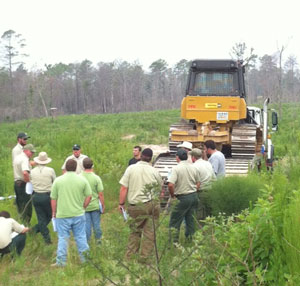 Recently-hired resource specialists got a chance to learn about water quality protection issues during a workshop in Hudson.
Forester Todd Thomas and Resource Specialist Bernie Buckner led the class to expose the new employees to Best Management Practices.
“The BMP training helped newer staff learn how to help mitigate water quality issues while they’re working in the forest,” said Forester Todd Nightingale. “They will be able to use what they learned to assist forest landowners with information, and it will help make them more proficient at fireline rehabilitation operations after wildfires.”
Participants got to install waterbars and learned how to manage site disturbances to reduce impacts to local waterways.
Monday, August 1, 2011
August BMP Q&A
By: Chuck Coup, BMP Forester (Ret.), Texas Forest Service
Q: There
are all sorts of difficult situations that can arise when my guys are
attempting to construct a functioning wing ditch. Sometimes they work and
sometimes they don’t. Can you tell me some of the most common problems you come
across with wing ditches?
A: Isn’t
it amazing how a structure as simple as a wing ditch can sometimes be so
troublesome! The primary function of a wing ditch is to collect runoff water
from the road surface and roadside ditches and disperse it into stable areas
away from water bodies or other sensitive areas. They are typically most
effective when used in conjunction with a waterbar that intercepts, diverts,
and drains runoff water from the road surface and the roadside ditch on the
opposite side. It is really nothing more than a water outlet for the road, but
knowing where and how to construct them in certain situations can be very
tricky!
One of the most common problems I see with wing ditches is that
they are longer than necessary. It is generally not effective to construct a
wing ditch that carries runoff water long distances away from the road. This
practice unnecessarily exposes additional soil to erosion and increases the
distance that the runoff water has to flow before reaching stable, vegetated
ground cover. Long wing ditches also run the risk of discharging polluted water
into or near water bodies or other sensitive areas. Keep your wing ditches only
as long as necessary to encourage the water to flow away from the road. One
exception to this may be in extremely flat areas where it is difficult to get
the water to drain away from the road. Typically though, if you have a little
topography, gravity will do the trick. If you think you need to construct a
long wing ditch in order to deal with a large volume of water being carried
down your road, you should instead consider increasing the frequency of your
wing ditches (and waterbars) by putting them closer together. That will divide
the amount of water you are trying to manage between wing ditches.
Another problem I often come across is wing ditches that are
constructed as narrow channels using the corner of the skidder or dozer blade. I
frequently see these V-shaped channels in combination with wing ditches that
are too long, resulting in a turnout that erodes and carries sediments excessive
distances – completely the opposite of what we want. A better approach is to keep
the dozer or skidder blade level with the ground and make a wide flat outlet
that disperses the water over a broad area. This kind of outlet promotes sheet
flow versus channel flow which spreads the water out and reduces its speed.
Slow moving water cannot carry sediments as efficiently as fast moving
channelized water can.
 Other problems are typically related to where the wing ditch
discharges. I occasionally come across waterbars that are correctly constructed
on the edge of an SMZ but have a wing ditch that carries the polluted water
through the SMZ and discharges it either directly into or within feet of the
stream channel. That’s bad news for the fish and other aquatic wildlife.
Another situation I repeatedly see are wing ditches constructed down steep
slopes which eventually leads to excessive erosion. One way that you might
avoid these situations is by putting a gentle uphill turn in your wing ditch
outlet. “J-hooking” your wing ditches, as it is called, can help to divert the
water away from sensitive areas like stream channels or steep slopes and also
helps to slow the water’s speed. However, don’t confuse this practice with the
futile attempt to carry water uphill by putting wing ditches on the high side
of the road or against the slope of the land. The wing ditch should still have
a slight down grade and follow the natural contour of the site (and be flat and
only as long as necessary). That’s one approach that I have found to be
effective, but I am sure that you guys have come up with more creative
solutions to these problems. If you have, drop me a line as I would love to
hear them!
Finally, if you get a chance, I would recommend that you go
back and take a look at some of the wing ditches you installed in the past,
especially the ones that you were uncertain about. See if they worked and if
they didn’t what you might need to do differently in the future.
For more information on wing ditches and other BMPs visit
the Texas Forest Service webpage at http://txforestservice.tamu.edu/water or
contact me by phone at (936) 639-8180.
* This article was published in the August 2011 issue of the Texas Logger
Wednesday, June 1, 2011
June BMP Q&A
By: Chuck Coup, BMP Forester (Ret.), Texas Forest Service
Q: When dealing with temporary stream
crossings, I have been told several things about where to put waterbars to
prevent road sediment from entering the stream. I have heard that you are
supposed to put a waterbar on each side of the streambank at the crossing to
prevent any water flowing down the road from getting into the stream. I have
also been told to never put any waterbars inside the SMZ. Would you please
clear this up for me?
A: It
is certainly easy to see how both recommendations could seem valid, but let’s
see if we can’t shed some light on this debate.
The thought behind closing out a temporary stream crossing
by constructing a waterbar at the edge of a stream is that it will provide a
place to stop or redirect any water entering the SMZ just before it gets into
the stream. However, experience has shown that waterbars at the streamside
typically serve more as a source of sediment. These waterbars will often slough
off into the stream with a heavy rain. If rains are heavy enough to cause the
stream to overflow its banks, the waterbar may be completely washed away.
Therefore, as a general rule, waterbars should be kept at
least 50 feet away from the stream channel (i.e., outside the SMZ). A properly
constructed waterbar at the edge of the SMZ will divert water off the road as
it approaches the SMZ and give plenty of distance for the water to slow down,
spread out, and drop any sediment before it reaches the stream. Just be sure
you don’t construct a long narrow wing ditch off that water bar into the SMZ
that will channelize the water and direct it into the stream.
Of course, as with any rule, there are exceptions. If your
SMZ is wider than the minimum 50-foot recommendation then it would be alright
to have a waterbar within the SMZ. If you are dealing with steep approaches and
erosive soils then it may be necessary to construct an additional waterbar with
in the 50-foot buffer. However, you should try to keep it as far back from the
stream bank as possible and be sure that it does not discharge directly into
the stream channel.
It is important that you also re-establish the original
slope and condition of the streambank as best as you can when you pull out your
temporary stream crossing. An effort should be made to stabilize the
streambanks where the crossing and approaches to the crossing were. Stabilizing
these areas becomes even more important for crossings with more erodible soils
or steeper slopes. This can be accomplished using grass seed or logging slash;
however, you want to make sure that any logging slash you put next to the
stream is well incorporated into the soil and above flood level so that it will
not wash into the channel during high flows. If this is done, there should be
little or no erosion at the crossing.
As always, the very best way to prevent sediment from
entering a stream at a crossing is to avoid putting in the crossing in the
first place.
For more information on stream crossing BMPs visit the Texas
Forest Service webpage at http://txforestservice.tamu.edu/water or contact me
at (936) 639-8180.
* This article was published in the June 2011 issue of the Texas Logger
Monday, October 1, 2001
October BMP Q&A
By: Hughes Simpson, BMP Forester, Texas Forest Service
Q: I have just finished logging a tract of timber and want to stabilize the road system to prevent erosion from occurring. However, this property is currently under a hunting lease, and it will see a lot of traffic during the upcoming deer season. I don’t want to block access to hunters by installing waterbars, but also don’t want to cause any impacts to water quality. What can I do?
A: This is a common problem that contractors face each hunting season. Millions of acres are leased every year for this recreational activity, which can contribute a substantial source of income to many landowners. It is important to provide access to hunters on these lands, and at the same time protect water quality.
Waterbars are very effective drainage control structures that can prohibit or limit access to hunters if not installed correctly. Building these devices too tall will temporarily keep people out until they can find a way to knock it down or level it out, undoing all of the good that you had intended.
On roads that will see heavy traffic, other erosion control alternatives should be considered. Rolling dips will also function in cross drainage, and make it easier for vehicles to travel road systems. These structures look like stretched out waterbars, and are excellent for use on steeper grades. Broad-based dips are not recommended for use on steep grades, but can allow for higher vehicle speeds.
Another technique that can be utilized is an open top box culvert. These are installed flush with the road surface at an angle of 30-45 degrees downgrade. Water should be transported off the roadway and allowed to dissipate into surrounding areas. A potential drawback to using this method is that they require periodic maintenance to make sure that the channel is free from any obstructions. They can also be safety hazards to horseback riders.
Creating partnerships with hunting clubs is an excellent way to protect roads from erosion and cut down on your expenses. Hunting clubs may be willing to revegetate roads with grasses or plants that will also serve as wildlife food plots. This will aid in holding the soil in place, keeping the road from washing out and possibly giving a hunter a chance at a trophy buck.
You can find out more information on broad based dips, rolling dips, and open top box culverts by consulting the Texas Forestry Best Management Practices Handbook on pages 40-46. If you have a question regarding BMPs, please call me at (936) 639-8180.
* This article was published in the October 2001 issue of the Texas Logger
Friday, September 1, 2000
September BMP Q&A
By: Jake Donellan, BMP Forester (Ret.), Texas Forest Service
Q: I have a question about wing ditches. My guys put them in whenever they think one is needed. I was wondering do you have any specific guidelines as to how many and how often they need to install them?
A: Wing Ditches are water turnouts that divert water away from the road and/or a side ditch. The purpose of a wing ditch is to collect and direct water from road surface runoff into an undisturbed area. It is necessary that the wing ditch allow the water to slow down and to channel the water away from the road and roadside ditches. There are some guidelines to use on when to install wing ditches and how often. Experience, which should never be downplayed, also plays a large role in knowing when and where to put the wing ditches along your roads.
You probably want to use wing ditches anywhere where there is an accumulation of water or a section of road or trail. The water should be diverted so as to decrease the volume and velocity of the water especially on slopes. You also should use wing ditches where there is a buildup of drainage water in roadside ditches. This buildup can eat away at roadbeds and scour out the roadside ditch itself. The recommended guidelines for wing ditches are on pages37 and 38 in the Texas Forestry Best Management Practices Manuel sometimes called, “the Bluebook.”
The spacing of your wing ditches depends on slope and soil conditions. On 2%-5% slopes the spacing should be no greater than 200 feet apart. On slopes 5%-10%, the distance between wing ditches should be no greater than 100 feet apart. Slopes greater than 10% should have wing ditches no more than 75 feet apart. Your experience should tell you that you might need more wing ditches if you are working on highly erodible soils. One other thing to keep in mind is that wing ditches should not feed directly into streams, gullies, or adjacent drains or ditches.
 Wing ditches should be installed so that they leave the road ditch line at about a 30 to 45 degree angle to the roadbed and be designed to follow the natural shape (contour) of the land. The runoff water can be spread out, filtered by brush, or retained in the wing ditch. Wing ditches are very effective tools to help maintain roads and trails. Wing ditches can be even more effective when used in conjunction with other road BMPs like water bars, rolling dips and crowning the road. I hope that answered your question. Does anybody else have any other suggestions or methods that they use?
If you are in the area stop by see me. If you have a BMP question you would like answered, please contact me.
* This article was published in the September 2000 issue of the Texas Logger
Subscribe to:
Posts (Atom)